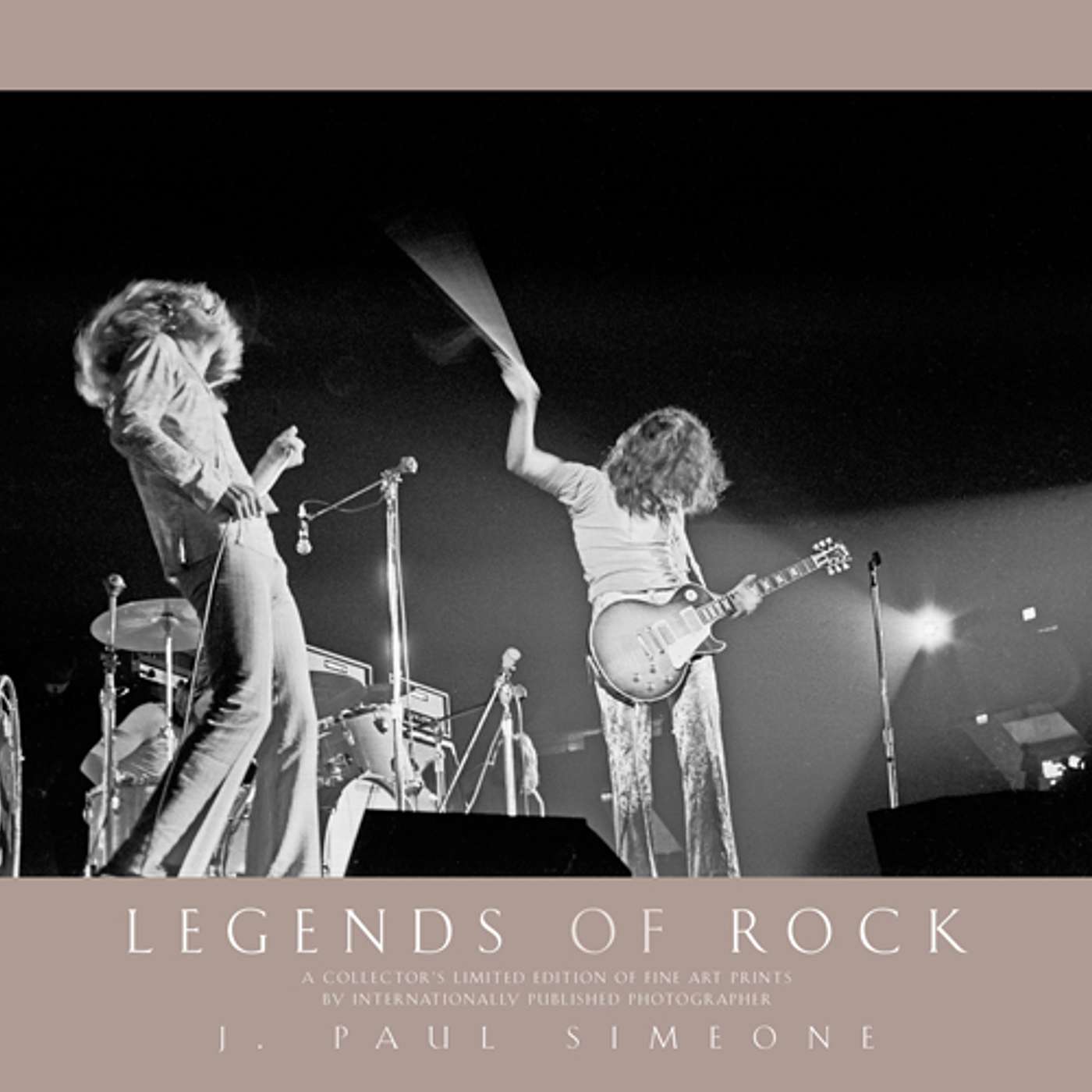
The Concert Room welcomes Photographer Paul Simeone to the show! The legends of Rock!
The Program
The concert room welcomes renowned local professional Photographer and Cinematographer Paul Simeone to the show. Paul has a vast portfolio on his website shooting clients that include portraits, the fashion industry and corporate photo shoots, and within his portfolio is the Legends of Rock gallery. These fine art prints from the early days of concerts and shows captures bands in the early days on various stages in and around the Philadelphia area. Legends such as Zeppelin, The Dead, Hendrix, The Who and many others along with sitting portraits of the stars of the day. Paul takes us inside his wonderful personal collection and stories of events and shows! These limited-edition photos are available to the public for purchase, framed, numbered and signed by Paul personally. If you are able, please click on the link below and view the rock legends gallery and follow along while listening to our show.
Website:
Legends of Rock Portfolio:
SPEAKER_00: And thanks for tuning in today. Have a great show as we dive in deep in the world of rock photography from the early days of rock concerts. My guest today is Paul Simeon. He is a local photographer and cinematographer. Paul has a gallery on his website titled Legends of Rock. It's this gallery of early rock photos previously unpublished from his personal collection that Paul shot in the Philadelphia region back in the late 60s and early 70s. Snapping shots of moments on stages that really no other photographer was able to capture at the time.
SPEAKER_00: Paul gives us the backstories of these rare and wonderful photos today. And I'm really excited about this conversation. These photos are available for sale in his rock gallery, framed and signed on his website, which is jpaulcem.com. Last name spelled S-I-M-E-O-N. And again, these will make a great addition to any collection. So let's get started and welcome Paul to the show. Welcome to the show. I appreciate joining me today. Just a little background for Paul. Were you born and raised here in the Philadelphia area or did you move here from somewhere else?
SPEAKER_01: No, I'm born and raised uh born in Lansdown, Pennsylvania, and then my family moved to Morton. So I'm uh I'm a Delco boy, so to speak. Um and uh uh born and raised in Delco in late school and high school and been here ever since.
SPEAKER_00: We we were talking earlier before we recorded this. You mentioned that were you a musician? You learned an instrument? I'm a drummer. Yeah, okay, great. So and still play. Oh, awesome. Play with friends or bands? You do you play out?
SPEAKER_01: Well, back well, in high school I was in a band. We had a band that was made up of our neighborhood kids, and the band back then was called the Mandels. And we actually played I played at my eighth grade commencement dance, and then we had the high s the uh band through three years of being in high school, and the band kind of uh ended when I was a junior in high school, and and anybody that was in that band kind of went through different ways. Yeah. And uh, you know, and and they kind of like made pretty much little names of them for themselves.
SPEAKER_01: My guitar player uh was pretty much of a uh uh a legend in the tri-state area. His name was Jim Sileski. And uh yeah, so he uh he went out on his own, went with various club bands, Wildwood bands, shore bands, so to speak, and uh ended up owning a couple of music stores, one in Delaware, and then the most recent one is uh the music museum over in Pittman, New Jersey. And uh a lot of the so-called my musician friends uh back in the day who were guitar players kind of really looked up to Jimmy. He was he was kind of a legend in the area, and unfortunately he passed away about a year a year and a half ago.
SPEAKER_01: Yeah, so so and then I I continued to to play, went to community college in Delaware County for about a year or two, and then went got myself involved in a wedding band, and then picked up harmonica to play harmonica a little bit, and then uh continued playing drums even to this day. I grew up in a in the my father was uh was a drummer. In fact, he played with uh he did a six-week tour with uh the Glenn Miller band back in the day before the war. Wow. So yeah, so I yeah, I grew up in a household of music, listening to a lot of the big band groups like Tommy Dorsey and Artie Shaw and Glenn Miller, and listening to drummers like Gene Cooper and Buddy Rich.
SPEAKER_01: Then growing up in an Italian household, you listened to Frank Sinatra and Louis Clima and all that. So I stayed with I stayed with it, you know.
SPEAKER_00: So Yeah, that's great. So more jazz swing, or did you get into rock? I mean, as a kid you got into the rock, right? But you just swing back to the big thing.
SPEAKER_01: Yeah, listening to that and you know, and you know, my listening to my father play, and then I took lessons for a short time. But I think, you know, once I once I started to play on my own and listening and you know, gravitating towards the kids in the neighborhood that formed the Mandels, we uh started to listen to bands like you know, the British invasion, a lot of Beatles, Rolling Stones, uh, the Yardbirds, we became huge, huge Eric Clapton fans back in the day. So especially with Jimmy being our guitar player, he was a huge Jeff Beck fan and Eric Clapton fan.
SPEAKER_03: Right.
SPEAKER_01: So when we when we started to listen to those guys, we kind of like did our research and found where these guys were playing, you know, in the bands where they came from. So Clappin coming from and uh Jimmy Page and Jeff Beck coming from the R the R-Birds, and then myself become becoming a huge Eric Clappin fan, I just followed in from one band to the other, which really prompted me to, when I was in high school, to go to see these these bands and see these musicians playing in the local venues.
SPEAKER_01: And that's how I got really started in my photography career.
SPEAKER_00: That's what I was gonna ask you. Started bringing your camera in or Yeah, exactly.
SPEAKER_01: I mean, when I was younger, my parents bought me one of those little dark room kits that had a contact printer and a couple of trays and chemicals you would make. And I actually have my parents' brownie camera, which I still have today. Oh wow. Uh and then I would go out and buy film and then you know, process the negatives and then make contact sheets and doing all of that. But once I started to go to these venues, like the original Electric Factory and and then, you know, gravitating to all of my friends who were just all musicians, I would go to these venues and this guy's walking around on stage with multiple cameras around their neck.
SPEAKER_01: And I'm thinking to myself, well, I can do that. And that looks like kind of interesting. So I had a paper route and all the money that I got from my paper route, I would end up saving it to buy a camera and then did a little odd jobs until I was able to afford to buy a lens and then buy chemicals. I set up a dark room in my parents' house, and that that started me, you know, doing these going to these venues to shoot these bands that I was, you know, loved to listen to. And you know, those were pretty much the two venues where I really concentrated most of my photography and most of my images and where my images came from.
SPEAKER_00: Yeah, the uh electric the original electric factory for anybody that doesn't know is that was down on Arch Street, if I remember. That was an old tire factory, wasn't it?
SPEAKER_01: Wasn't that the correct 22nd and Arch. It was it took one city block. It was a venue for people to go to to listen to music. And it came very kind of controversial back then because it attracted a lot of people, a lot of young people of diversified cultures, young kids and and all of that. And that kind of like really put a sour taste in the neighborhood. A lot of the people who who were living in that neighborhood really didn't like the people it was attracting. And it got into a lot of legal issues and issues from people like um if anybody remembers the police commissioner and ultimately ended up becoming the mayor of Philadelphia.
SPEAKER_01: Frank, Frank. Frank Frank Frank Rizzo. And Frank Rizzo had it in his in his mind that he was going to shut it down. And I remember hearing a story told by Larry Maggot that somebody came to the front door of the building, and one of the employees went to get Larry in his office and said, Somebody out front that wants to talk to you. So Larry walks out front, and it was Frank Rizzo. He was a police commissioner at the time. So he went up to Larry and says, Are you the owner? And Larry looked at him and said, No, look, let me go get my partner.
SPEAKER_01: Let me go get the other guy. So, but he he had it in, he had it, he was going to shut it down. He said, This is this is no good for the community. You are not not welcome here, and this and that, and blah, blah, blah. And and tried to shut it down, tried to sue him, and it never really, never really went through.
SPEAKER_00: Wow, because a nuisance, I guess, right? He thought it was a nuisance.
SPEAKER_01: Yeah, he thought it was a nuisance. He thought it was attracting a lot of undesirable people for the neighborhood, and he had it, he had it in his crosshairs that he was going to shut it down. And it would never it never materialized. So Larry Maggot won. I think the I think the factory was open for about maybe two years, started in 1968, and then eventually moved uh somewhere on Spring Garden, I believe. And uh at that point, that launched Larry's promotional and type of career, and ended up becoming one of the largest concert promoters in the country.
SPEAKER_01: Uh anybody who was anybody had to go to electric factory concerts in play, Philadelphia.
SPEAKER_00: Yeah, yeah, yeah. On the tickets and just legendary.
SPEAKER_01: So when you bought a ticket to go to the Spectre and to see Led Zeppelin or Jimi Hendrix or anything like that, it was electric factory concerts.
SPEAKER_00: Yeah, presents, that's right. Yeah, yeah. Wow, that's amazing. And good for him because he can book well, he's a promoter. He's got he's got his own venue. Before the electric factory, what was it, the convention center or bands would go through uh Yeah, you had you had you had the Philadelphia Arena.
SPEAKER_01: Uh that's what it is. Yeah, and then I mean as the electric factory started, then you had other venues in Philadelphia. I remember the Chesna Cabaret was another venue that you could go see bands, and then you had the small little coffee houses like Grendel's Lair and um Main Point. A couple of other that was out of the city, that was on the main line in Bernmar. That's right. Uh then you had Grendel's Lair and Cafe Goga. Uh Cafe Agoga was out of New York. And was it TLA? TLA. I don't think that was I don't think that was a lot of things.
SPEAKER_00: That was still a theater, I think. Like a movie theater, yeah, that's right. Right. Um, just trying to get a timeline here. Yeah, that's interesting because this is way before my time. Well, it's always good to well, it's always great to talk to somebody that was there because we all have our first concerts. I mean, mine was until 80, but I grew up in the 70s. I was too young, you know, obviously, to to go to concerts. But growing up with three older sisters, I listened to all the music and just couldn't wait to get you know into uh into the spectrum, if you will.
SPEAKER_00: But so it's always great to talk to someone, you know, that's there, you know, from the beginning and seeing these bands that came through and then eventually moved into the spectrum or the tower, right, you know, later. What was your first concert by the way? Or was it the was it at that venue or was it one of these smaller ones?
SPEAKER_01: I think it was the factory. I think it was the Arctic Factory. I mean, I saw I'm not sure who was there first. I remember hanging out at a guitar store in Philadelphia called Guitar Workshop. And Todd Rundrum would go there all the time. He was always there hanging out. And so when the Mandels were playing and we moved into these different types of venues, because my father was the manager of the band, so we we we played a lot of venues in the Philadelphia areas, and then we entered a couple of battle band contests and all of that.
SPEAKER_01: But I think I think probably I mean it could have been cream, uh it could have been uh oh no, uh, I think it was uh uh cream at the Cafe Gogo in New York City, and that was in 1967. Yeah, and that was their first United States concert date uh in a club date in in in the US. And then from there they went to the factory, they played three nights at the electric factory, uh Good Friday, Holy Saturday, and Easter Sunday. Easter week, wow. Easter week, and I remember well, I was there all three nights, and that was an interesting night because interesting concert because Eric Clapton at that time was playing his Gibson SG, the painted SG, the psychedelic painted SG.
SPEAKER_01: So he played that on Friday, but on Saturday, apparently something happened to the guitar. I wasn't sure I don't think it was stolen, I think something technically happened or electronically happened to the guitar. So he went to downtown Philadelphia, Music City, and bought the Gibson Firebird, which is what he used on that Saturday night. Well, then I have those pictures of him playing that guitar. Yes, yeah, you know, so and then I saw Cream at the at the spectrum, and and then I saw Clappin' Blind Faith at the spectrum, and Jimi Hendrix at the spectrum, and then and you know, a lot of a lot of the the bands at the original Electric Factory, Manford Man, uh just it just went on and on and on.
SPEAKER_01: Blood, sweat and tears, mountain, Jimi Hendrix, Santana.
SPEAKER_00: They were Joplin played there, I believe.
SPEAKER_01: Yeah, yeah. That was the place to go. I mean, that was that's where you went it. You know, we'd buy a ticket, get myself in. Back then they weren't really checking what you would bring into the venue. So I had a camera bag and I would get into my seat, and then when the show would start, I would put two cameras around my neck. Wow. I mean, I looked I looked official, and I would right walk right up to the front of the stage and I would stand there and start taking pictures.
SPEAKER_00: That's unbelievable, isn't it? That would never happen today. Well, you can't do that today. No, you can't do it today. You can't do anything today with that. Right. Yeah, they were a little looser.
SPEAKER_01: I mean, so you could just start shooting and bands and there was no bodyguards to hassle views, just same thing at the electric factory, and I remember there was a there was a uh venue, I think it was in 1970, the Temple Music Festival, which was on the set the uh grounds of Temple Ambler campus. Right. And that yeah, and that music festival was a band called Cactus, which was uh one of the opening, I think, I think the Manhattan Transfer had also played that venue.
SPEAKER_00: Okay.
SPEAKER_01: And then Steve Miller Blue's band with Boskax playing guitar.
SPEAKER_00: Yeah, wow.
SPEAKER_01: And then uh The Grateful Dead, which um yeah, and they opened and they all opened for Jimi Hendrix, who was who was the headliner. And I made myself kind of like this bogus press test that would allow me to get in. And you know, the the the people who were in charge of it looked at me as being the official photographer, so to speak, and uh I ended up having carp lunch. I and I went any everywhere. I was in Jimmy Hendrix's dressing room. I was behind the scenes, I was behind the stage. I was, you know, a lot of my photographs show that behind the scenes type of images.
SPEAKER_01: And being on stage with uh I remember being in Jimmy Hendricks' dressing room and and waiting for him to arrive. And then I walked out on stage first, and Jimmy followed me along with Mitch Mitchell of that show. And I was on stage uh with Jimmy, you know, so but yeah, I mean I you know I talk a a lot about this with friends of mine who are my age and people that I know that actually went to those shows. And you know, we we were really fortunate to to really be involved in that kind of time period of that music, and it really set the bar for everything that's happening today.
SPEAKER_01: I mean, I don't know if the music in my mind I think is very different today than it was back then because back then it was it was very organic. It was four or five musicians playing electrical electric instruments on stage.
SPEAKER_00: Yeah, I agree. And it is different, it's more like a show nowadays. I mean, before, well, even before like music got to be big business, you know, with the lights and the show and everything else, uh excess, you know, the eighties. But you're right, back then, you know, they put an album out, they go on tour for a year or 16 months, and they would just uh kill it every night. And they didn't uh you know there was a lot of freedom back then too, I found that they could play really anything. And if you didn't like it, you didn't buy a ticket, you didn't buy the album.
SPEAKER_00: But there was so much music out there for everyone. Uh they had the freedom to do whatever. If they wanted to do a 13-minute tweet, they could do that. The yes was playing 15-minute songs, you know, you could do that.
SPEAKER_01: And well, the great the Grateful Dead was notorious for that. Yeah, exactly. They were notorious for that. You know, those those those shows went some of those songs went 30, 30 minutes long, 40 minutes long. You know, it's pretty incredible.
SPEAKER_00: Yeah, I think they put out albums just so they can get out on the road for like 18 hours and just because that was the jewel of their band was live, obviously. They just had to get out on the road. That's where the they were a live band. Uh but you're right, they'd had the freedom to do that. And nowadays and your attendance band was there to watch. Yeah. We didn't we weren't on phones and we didn't have outside uh things where you know we're bouncing from one thing to the other like we are today.
SPEAKER_00: Right. But that's what I used to love about going to concerts is just for two and a half hours just watching a great band that I love. Right. You know, that I've grew up with or I've played their albums and now I'm playing them live. And you know, it's just you walk out and you're like, this is great. You know, I need to get more tickets. Uh and back then, I'll tell you what, Philly, it was like a conveyor belt with all these bands that came through. I I look at these even like a monthly thing from like the magazines and and uh the Spectrum magazine and you know announcing shows and just bands after another, one after another.
SPEAKER_00: You could just pick and choose.
SPEAKER_01: Well, Philly, I mean Philly had had its own little dynamic in terms of how it how it positioned itself within the music industry. I mean, especially if you go back to, you know, the Motown days, and Motown kind of had their own little genre in terms of the of the kind of music that you were listening to, the Supremes and the Four Tops and the Temptations and all of that. But Philly took it to another level, especially with Philly International Records. Right. With people like the OJs and the and the stylistics and MSFC.
SPEAKER_01: They took they took that that music that was developed by Motown and add another level to it, especially by adding very lush strings to it. And you know, I remember being being a kid and when I had I had a studio on 12th Street, which is down the street from Sigma Sound Studio, and I got friendly with a guy by the name of Weldon Arthur McDougall III, who was an A and R guy from Motown, and then eventually ended up doing the Philly International. But I met I met I met Weldon when I was working in a camera store, and Weldon was a photographer, and he would drop off, you know, 10, 15, 20 rolls of film to have a process.
SPEAKER_01: And I remember one night, you know, working there, and and this guy would always come in dressed to the nines, full-length leather jacket all the way down to his ankles, and drop all this film. And I'm thinking to myself, this guy's got to be somebody. And I ended up opening up some of his pictures, and they were the behind the scenes of people like you know, the four tops or cool in the gang or anybody like that. And he came in one night and he's looking at his pictures, and he's just he's frustrated.
SPEAKER_01: He goes, I can't get this right, everything's too dark, it's too light, it's out of focus, this and that. And I would give him tips, pointers on how to fix it. So one day he said to me, he goes, Well, why don't I just take it with me? I said, What? He goes, just come with me, you know. So we ended up shooting Cool and the Gang at the old Tally Ho, no, I mean at the Bobby Floyd Music Fair, and then the Jackson 5 down at the Spectrum. And uh wow. And then when I left the camera store, I I went to this, I had the studio down the street from Sigma, and Weldon would call me and go, Oh, by the way, Billy Paul's in town.
SPEAKER_01: I'm gonna send him down, so I needed to do a headshot. So I would do a headshot of Billy Paul, and then he called me and said, Lou Rolls is in town. Come on down and let's do a shot of Lou Rawls. And then I did Bunny Ziggler and Pala Melvin and the Blue Notes, and you know, that was my connection to Philly International Records. Uh and uh, you know, and then I ended up in a band called Drift Silver, where I was playing percussion and the uh Thomas' daughter recording soundtrack, and we hired and I was in and I was in the control room, and her name was Carolyn Mitchell, and I'm in the control room with the keyboard player who learned the jingle, and this girl hits the tagline and kills it.
SPEAKER_01: And I look at the sound engineer and I said, Hey, man, she's really good. And he goes, You think she's good? You ought to hear her girlfriend. Well, her girlfriend was Bernice Thomas. So we ended up meeting her. She she went to Swathmore College, she ran the gospel choir at Swathmore College, and we ended up putting a quick little band together with her and Carolyn and myself and Jim McGorman, who was the keyboard player. Wow. And we had we added two more people, and you know, we had we took some we took some of our Original songs down to Harry Chippets, Sigma Sound to listen to those songs.
SPEAKER_01: And he said, he said, they're really good. He goes, but I'm I'm only interested in publishing rights. I want to own all the publishing rights. And Vanessa, Vanessa and I looked at each other and we just went, No, that's not gonna happen. And then we walked out and that was the end of that. But Vanice went on to do better, you know, things. She was uh background vocalist for uh Slapton, background vocalist for uh uh Aretha Franklin and all of that. But uh it's always been you know the brother-sister thing for me for for my entire career and still doing it today.
SPEAKER_01: I still feel like I'm 12 feet tall and bulletproof, and I still feel like I'm the onslaught being stuck a little fire.
SPEAKER_00: Ah, that's great.
SPEAKER_01: Uh I you know, I uh somebody mentioned a line about getting old and this and that, and what you don't want to do is you don't want to let the old man in. Right, yeah.
SPEAKER_03: That's right. You gotta keep busy.
SPEAKER_01: Yeah, gotta keep busy.
SPEAKER_00: You know, this yeah, you're I'm looking at your pictures now on your website, and I do see Lou Rawls and Yep. I'm sorry, who's the gentleman in the hat dress? That's Billy Paul. That's Billy Paul. That's Billy Paul, okay. Because they're all your shots, at least on your website, are the action shots with the uh studio. Yeah. So I was wondering how you got the uh the headshots of that. They're great.
SPEAKER_01: Yeah, they were studio shots. In fact, that's when the welder would call me and go, Oh, by the way, uh Lou Ross is in town or Billy Paul's in town, sending down the studio. And all they did was just walk down the street because I was I was a block and a half away from Sigma Sound. Oh, that's great. These pictures which they were taking with black and white, you know, so it's fine. It was really fun.
SPEAKER_00: Yeah, I wanted to ask you, so to segue into that, because a lot of color shots with bands, but some of your best shots are the black and white. So did you do that on purpose when you went out, or did you did you shoot in color and say this looks better in black and white?
SPEAKER_01: No, I saw it, I saw it, I saw it in black and white. I think back then as well, when you because you were shooting an available light uh and you weren't using a flash on camera, you needed you needed film that had a high ASA setting, like 1600 or 1200 ASA. And then it you would you would push it in processing, but when you did that, it got very grainy. And but a lot of people and I wasn't doing my own color. So most of the black and white stuff I processed myself. So if if I had a if I if I was shooting Led Zeppelin at the spectrum and I had 15, 16, 17 rolls of film, when I got home the next day, I processed all that film by hand.
SPEAKER_01: Uh in the in the camp in the chemicals in my dark room, and then you know, everything was, and then I would make contact sheets to look at the shots of three or four images that I thought were the best. Right. Now, again, I'm in high school at this point. And I would, you know, I would make probably, I don't know, maybe four or five or six or seven black and white eight by ten glosses of each guy that was in the band. And I took them to this place in 69th Street called the Record Museum. And I got friendly with the owner of the Record Museum.
SPEAKER_01: So I would go there probably the day or two after the show with about 15 or 18 2810 black and white glosses, and he would pin them up on the wall at the record museum, and he would sell them for like two or three dollars a piece. Oh, okay. So so then I would back go back at the end of the week and I would pick up my thirty, forty dollars or whatever it was, and then you know, that would I would use that money to buy more chemistry or buy more film or you know, get a get another lens or the or something else that I would need.
SPEAKER_01: The photographs of cream at the factory, they were taken with a flash on camera. And I was front row with that. So I can only imagine how irritating it must have been to either Clapton or Jack Bruce. Oh, you had a flash on them? I'm looking at it. I had a flash on it. Yeah, I had a flash on it.
SPEAKER_00: So they're a little brighter. Yeah, and then I think they didn't like tell you to knock it off or something. Usually that's a no-no. Yeah.
SPEAKER_01: Yeah, there's a shot. Oh, there's a shot of on my website, there's a shot of Ginger Baker. And if you look at that photograph, there is kind of a the Arctic factory had a light show. And the behind behind the stage was white sheets. And they had like oil lamps, or they had like a a projection type of light that you they would put different color oils on the glass, and that would that would change all the colors behind the artist. Well, that photograph of Ginger Baker, you can see there's kind of like a very bright specular light behind him.
SPEAKER_01: That was what the light show looked like. Yeah, I'm looking at it right now, yes. But if you shoot with a flash, the flash blows that out, so you can't see that. Oh, okay. So, you know, the the shot next to the baker uh sitting there with on the drum kit with his left hand up in the air, that was taken with a flash. But you can't see the light behind him because the flash blows it out.
unknown: Yeah.
SPEAKER_01: Yeah, so but the stuff at the spectrum was all shot in available light, and that's what gives you a little bit more obvious in terms of what the sh what the lighting looked like at the show.
SPEAKER_00: Yeah, I can see the yeah, you're right. I see it. That's awesome. Yeah, I think the black and white is more dramatic. I do see a little bit of greeniness, and this is with everybody, I guess, back then, but the black and white, the but I you mentioned Zeppelin, and uh one of the greatest shots is Jimmy Page. I'm looking at it right now. I've seen it before.
SPEAKER_01: With the bow in his hand.
SPEAKER_00: Yeah, that's that's a spectacular shot. And how did you get did you just start snapping and then you looked at your your prints and be like, oh, that's a winner right there.
SPEAKER_01: Well, that's definitely the iconic, the iconic image of what Led Led Zeppelin was all about.
SPEAKER_03: Right.
SPEAKER_01: Uh and uh yeah, that's uh you know, it's you you you just keep shooting. Uh and you know, you you just you're just waiting for something to happen. You just keep shooting, and and uh I just happened to catch that. So I I was pretty lucky to get that.
SPEAKER_00: But yeah, that that is the iconic Led Zeppelin photograph. Absolutely. I mean plants waving his hair. You could just see the freshness and the we know what he's playing. It's probably the middle section, right? Of Daisy confused. He's doing the bow. He's got the bow and it's swinging it, and it's just amazing. It looks like he's got velvet pants on, so is it the 70s show with the spectrum?
SPEAKER_01: Yeah, I think it was no, it was probably 70s. I I think his pants were pink.
SPEAKER_00: I think it were pink velvet, right? Yeah, yeah, yeah. I think you're right. But again, the black and white, it's just so dramatic. It's it's really awesome. And there's a few other ones, the full band there.
SPEAKER_01: And you know, and uh as a as a as a more of a promotional type of situation, and and you know, these photographs that I've had, I think I just started to really go back to the original negatives that started digital making digital scans of them, high-res digital scans. And then that's when I decided that I was going to put out a limited edition of these images signed and numbered by me. And they really haven't been promoted a whole lot, so they're not out there for people to see. I had I had a I had a show that hung last year in May at a place called Jamie's House of Music, which is in Lansdown, and that's kind of a blues venue.
SPEAKER_01: And I saw three prints on that one, and then I just had this this past year, November, from the beginning of November to the end of December, I had a show that was hanging at a place called the Uptown in Westchester. And I had about 2530 photographs framed hanging at that show. But I guess it was right back in maybe in the middle of COVID, I got an email from a gentleman by the name of Kristen Larson, who was putting a book together. He was from Denmark. He was putting a book together on the history of Eric Clapton, the live history of Eric Clapton.
SPEAKER_00: Oh, okay.
SPEAKER_01: And he found me on the winner on the internet and he reached out to me and he wanted to see some of my photographs because the book depicting of Eric Clapton playing live that had not been published before.
SPEAKER_03: Oh, nice.
SPEAKER_01: So we actually talked on the phone. I sent him a half a dozen photos, and he picked out one, and that you know, he bought it and put it in the book, and that photograph was like Clapton playing his West Fall, and that was at that was at the uh that was at the spectrum. So that photograph at the spectrum ended up in the book.
SPEAKER_00: Oh, nice. Yeah, I'm gonna scroll. Yeah, I just saw it. Yep. Okay.
SPEAKER_01: Yeah, so and then I saw that's exciting. I mean that I saw Clapton with Delaney and Bonnie at the spectrum, I mean at the factory, uh, and the Who at the Factory, I mean at the spectrum, and um B. King at the spectrum, Closure Shows and Nash at the Spectrum, Closure Shows Nash and Young at the Spectrum, and Free Dog Knight at the Spectrum, Jefferson Airplane at the spectrum.
SPEAKER_00: Yeah, their airplane shots are great, great slick. Yep. Yeah, and and Jimmy at the Jimmy at the spectrum. Yeah, I'm scrolling through. Oh yeah, they're great. And John Mail. I'm sorry? Yeah, John Mayle at the spectrum too. Uh this Grateful Dead picture looks early, like 70s, JFK? Was that like a press? The one of Jerry Garcia? Yeah, there's two, I think, with the Jerry Garcia, Mickey Hart.
SPEAKER_01: Yeah. Yeah, that was that was the Temple Music Festival. That that is they opened for Hendrix. Right, okay. And that photograph was behind the scenes. So you the the the shot of the three members of Grateful Dead is Bob Weir, Mickey Harton's picture. I mean, is Jimmy the Jerry Garcia picture is uh at the stadium before. And a funny thing about it is I'm I'm very friends with uh good friends with uh the guy from the Hooters, Eric Bazillion. Yes. And Eric and I we've we've talked a couple of times because Eric has been to a lot of the shows that I've been to and has similar photographs.
SPEAKER_01: So he made a comment. I was talking to him probably about a month or so ago, and he made a comment to me about the photograph of Jerry Garcia taken at the Temple Music Festival. Well, if you look at that photograph and you look to the right, it's a guy that's scratching his head. He's got his hand up to his hair.
SPEAKER_00: I see it.
SPEAKER_01: That's that's our present. That's yeah, he said to me, he goes, Paul, I think I'm in that side. Oh my god.
SPEAKER_00: And uh that's all right.
SPEAKER_01: Yeah, pretty much. How did he get there again? Behind he had a bogus press pass as well.
SPEAKER_00: Oh my god, you guys are crazy back then.
SPEAKER_00: I talked to so many people on my show, and that's uh yeah, there was that seemed to be a thing back then, and that was just that's brilliant. Oh my gosh, that's awesome.
SPEAKER_01: And nobody hassled you, and you were just able to walk around and no, I remember when when I was at the when I was at the Temple Music Festival and I walked out on stage before Jimi Hendrix came out. Oh my god. There was a guy in front of me, he was on the ground and he was behind the barrier, and he's reaching out to me and he's going, How did you get on stage? And I showed him, I showed him my press pass. And he goes, Well, how did you get that? And I said, Well, it was given to me by by the people that I'm working for, which it was bogus.
SPEAKER_01: And he came down, he came down from Montreal specifically for that concert. And he could not get on stage. He was just pretty funny. But I think, and then I was talking to Eric about a month ago, and Eric told me that he was in Jimmy Henriksen's dressing room the same time I was. But Eric had pictures, took pictures, but the phone was lost. He never he never found the picture.
SPEAKER_00: Oh, that's a shame. Oh my gosh. Right. That is hilarious. Yeah, I'm looking at it, and yeah, there he is. Well, you also had a great story with him circling back to Clapton's guitar right at Music City. Yes. That's hilarious. Because to me it's small.
SPEAKER_01: I was put a definitive answer to the show of the dates of that show, which was the 12th, the 13th, and the 14th of in 1968 of April, which would have been Bushwadi, Holy Saturday, and Easter Sunday. So I was contacted by a guy, I guess somewhere in Connecticut. He some of my pictures ended up on the Creams Facebook page. And this guy posted that the photograph that I took of Clappin was taking on the 20th, the 20th of April. And he reached out to me and he posted that, and then he got this kind of you know aggravating email from Nettie Baker saying that his date is wrong and he needs to take it down because Nettie Baker said that the uh that the concert was the 12th, the 13th, and the 14th.
SPEAKER_01: And he he said, No, you're wrong, because he had a photograph of Clapton playing, was taken on Sunday, Clapton playing the Firebird. And how this whole thing happened was that there's a famous photograph of Cream sitting on the railroad sitting on railroad tracks that was taken in Chad's Ford. Yeah. I don't know if you know if you know that photograph. I know it well. Yes.
SPEAKER_02: Okay.
SPEAKER_01: Well, that photograph was taken by a guy by the name of Art Kane. Now, Art Kane was a photographer working for Life magazine back in the day. As a matter of fact, when I was starting my photography career, I followed Art Kane because he took a lot of iconic photographs of rock stars back then. So when we were we were talking on the phone about the date, I very distinctly remembered that it was Good Friday, Holy Saturday, and Easter Sunday. And I actually called my keyboard player at the time, my bass player at the time when I was in high school, because he was at the show.
SPEAKER_01: And he goes, Paul, it was it was Good Friday, Holy Saturday. He goes, I know, because I was supposed to go to my brother's engagement party and I couldn't go because I went to the cream show. So he he made it, he validated of that being that date. But the photograph that was taken that this guy took with his brownie camera, photograph taken of Clapton. Clapton is playing the firebird, but he's wearing the exact clothes that were taken that he wore in that photograph at Chad's Ford. And he and he he says that the image was timestamped from the processing lab on the 21st of April.
SPEAKER_01: And I I it it just it started this whole rabbit hole. So I called, I tracked down the the estate of Arkane. And Arkane passed away many years ago, but his son Jonathan Kane runs his estate. I called I called Jonathan King. And he said to me, he goes, Paul, my father didn't keep any good records. All I know is that the original 35 millimeter slide is stamped April 1968, but no day.
SPEAKER_00: Oh, I gotcha.
SPEAKER_01: But he does remember his father telling him that he was going to Philly to see cream on at the Letter Factory on Saturday night because he was going to be in town to be there on Sunday to take the photograph of them on in Chad Sport. On the track. But he didn't on the track, but he didn't have the date. So then I called Eric Brazilian. And Eric said, I said, Eric, I said, Do you see cream at the factory? He says, Oh yeah, man. He goes, they had all three nights. I said, Do you remember the date?
SPEAKER_01: And he went, No. And and I said, okay. He says, but I do have a story to tell you about the guitar. I said, you mean the firebird? He goes, yes. Eric was 15 years old. He was at home. He went to Music City on Saturday. And Ella says to Eric, look at this guitar I just got in. And it was the Firebird. So Ella says to Eric, Eric says, I want it. He goes,$150, you can have it. He says, I'm gonna go home and get the money. Eric leaves, goes home. He doesn't have enough money to get the guitar, never went back to Music City, and goes to the cream show Saturday night at the factory.
SPEAKER_01: And hears that Clapton was in Philly buying a guitar.
unknown: Right.
SPEAKER_01: Well, Clapton walks out on stage with the Firebird, and that was the guitar that Eric Lazillion wanted to buy. Oh my God. It blew his mind.
SPEAKER_00: Oh my God. He must have been what a great, great story. That must have been like, what the heck? My God, there's my guitar. Exactly. Exactly. My hero's playing it, by the way, too. Right. Right. Oh my god. Not just some schmo came in off the street. Eric Clapton.
SPEAKER_03: Yeah. And I and I love it.
SPEAKER_00: That was his favorite guitar too. I mean, went on to play that.
SPEAKER_01: I I loved, I loved all those behind the story, behind the scenes type stories. Well, there's a there's another there's another story of that that I can't well, this the photograph was taken late afternoon. Uh, because there's a sunset that's behind them. Right. And again, going back to that, trying to find out the exact date and that rabbit hole that was created, I called my cousin, who went to the show with me that night. Who went to the show that night. And he said to me, he goes, Paul, he goes, Don't you remember we we helped the the stage crew carry Ginger Baker's drum set into the factory from a white station wagon that was parked outside.
SPEAKER_01: Oh my gosh. What? And and he and I said to him, I said, Greg, I said, I don't remember that. He goes, Oh yeah, man, he goes, You and I, we carried the drums into the factory. They were setting up for the show. And I said, the white white station wagon, this and that, and blah, blah, blah. I mean, he had it right down to the detail. So when I when I talked to Jonathan Kane, Jonathan told me that there was a Super 8 video that he had a copy of that Ginger Baker's girlfriend at the time was taking Super 8 videos of behind the scenes stuff as they traveled.
SPEAKER_01: Well, Jonathan said to me, he goes, I remember seeing a video of my father, you know, a behind the scenes type of set was going to be. So he said he sends me the the video, Visition Wagon, with the drum set in it that they're taking the drums out to set up, which they never used of the shot on the on the um in Jazz Floyd. So I said to my I said to myself, my cousin was Dwight, because there's a White Station Wagon. So after the shoot, they came to Philly to do the Sunday show. And and I was there, and we helped him carry the drums out of the White Station Wagon to set up the water.
SPEAKER_01: That's incredible. And he remembered it, and I didn't remember that.
SPEAKER_00: You know, it was pretty incredible. Pretty incredible. That is, and then there it is in the shot, and then they just went right from there to to Yep.
SPEAKER_01: Now there also there was a story that was I can't get over this. And I and I I said to Greg, I said, first of all, I said, why the hell would they be driving from one venue to another in a station wagon?
SPEAKER_03: Right.
SPEAKER_01: Well, they they didn't have trucks back then that they rented, they didn't have a full crew of people that they went to every place that they they went. They just traveled whatever they were able to rent.
SPEAKER_02: You know?
SPEAKER_01: And there's a funny story about the about the photographs of Chad Ford, and it's online, it's on the internet. And I I I would have to think that they probably went and had lunch first. Looking at the way that they looked in this diner, there were a bunch of firemen that were in that diner and they were making fun of them because of the way they looked. And it caused a little bit of a stink in the diner. And the only diner that I could think of that would have been prevalent back then was a place called Hanksplince, which is still in business today.
SPEAKER_01: Oh, okay. And that's in Chad's Ford. And that and that is probably less than a half a mile from the site of where they put that photograph.
SPEAKER_00: That makes sense.
SPEAKER_01: And that would have been the only diner that would have been open at that time.
unknown: Right.
SPEAKER_00: You know, so pretty funny. Somebody out there probably has a magazine from that shot, the the Art Kane.
SPEAKER_01: Oh, you can get the magazine. You can buy the you can buy a copy.
SPEAKER_00: So would there be a date on that? Like taken, you know, Sunday, May April. Yeah, I guess not.
SPEAKER_01: No, I mean that you would have to you would have to go you would have to track it down probably through the editor back then. And that what was that? 60 years ago, 50 years ago, 40 years ago? Yeah. Nobody would have that kind of that kind of information. And I asked Larry Maggot, and Larry, Larry told me when I first asked him, he remembers that it was the 21st of April, and he remembered it clearly because Cream, Cream didn't want to do two shows, they only wanted to do one. And so when it came time to get paid, Cream says, Well, you owe it for two shows.
SPEAKER_01: So Larry Maggot said, No, I only owe you for one because he only played one show. Right. But and then when I asked Larry again, like a couple of weeks later, he said it was the twelfth, the thirteenth, and the fourteenth. So that whole rabbit hole of the date date has been bouncing back and forth.
SPEAKER_00: And she's Nettie's sticking by the week. I wonder if she is. Does she have information That we know like a something.
SPEAKER_01: I don't know. Larry Maggot had a poster printed. I have a copy of the poster of Cream Playing at the Factory, and the poster is dated to 12th or 13th and 14th. Right. When I questioned it, Larry said he didn't because they postponed the date, they didn't have time to reprint the poster, so they just went the following week. And the reason why the according to what I read, the reason why the concert was postponed was they were burnt out.
SPEAKER_03: Right.
SPEAKER_01: They wanted to take some time and they all went back to England. And then for 10 days to kind of recoup and then they came back. And I remember reading about that when when Cream played, Jack Bruce was playing through two or three Marshall stacks, or Clapton was playing through two or three Marshall stacks. And at one one venue, they were so loud that Ginger Baker couldn't even hear himself. And at one point he stopped playing. And Clapton and Bruce never even knew he stopped playing because they were so loud.
SPEAKER_01: So yeah, unbelievable. That's awesome. I love that. Really. I ran into a guy that uh when I was questioning the date at the factory, the opening act for that show would have been Woody's Truck Stop on on that Friday. Well, apparently Woody's Truck Stop did not was not able to do the show. And a band called Edison Electric took their place.
SPEAKER_00: Yeah, I've heard of both of these bands, yeah.
SPEAKER_01: Right. Well, the guy that's in Edison Electric is a friend of mine, and I see him on Wednesday nights. I go to the 4W5 blues night, open mic night on Wednesdays in at a place called the Reef in Delaware. Wow. And and the Michael Ziegler was the guitar player in Edison Electric, and he remembers the Friday night explicitly that he remembers they were the opening act for Cream at the fact.
SPEAKER_00: Wow, okay.
SPEAKER_01: Yeah. And he remembers the date being the 12th, the 13th, and the 14th.
SPEAKER_00: Right, which was Easter weekend. So everything points to that. I'm looking at your website and all the great photos. Not only that, you're the corporate photos and and everything else. So you moved into that, right? Uh like a different like shooting products and corporate, obviously people.
SPEAKER_01: Yeah, I mean back yeah, back in the day, I mean, some of those photographs were taken in 1970 and made in 71. But I had an interest in photography, so I wanted to try to stay into photography. So I had a I had a studio in Philly when I was probably around 22 or 23 years old. That's how I ended up shooting some of the stuff at Philly International Records. But I ended up getting a corporate job at the Franklin Mint in 1976, and I was their senior photographer and studio manager for about eight or nine years.
SPEAKER_01: Interesting. Great. And then I left the mint in probably 1991. I I can't remember, maybe then. Then I had a studio in media, and then I continued to shoot product photography and fashion photography for a lot of corporate clients and all of that. So that that kind of just I ended up through some through some of my musical connections. I ended up shooting a catalog for Chacamini guitars. Oh, no. And then I had and then I shot and Sonic, which was their keyboards back then, I shot their catalog. And so that kind of parlayed my interest with more music people and people that I met through the music industry that I ended up doing some of the product photographies as well.
SPEAKER_01: From the standpoint of the podcast, if people wanted to see more of the images, they would go to www.jpaulteme.com. That's my website. So you can go under Legends of Rock and they would see those images.
SPEAKER_00: Yeah, I'm definitely gonna you know put the link there or everything else, obviously, in the show notes, yeah. Because people got to go out and see these photos.
SPEAKER_01: And the images are for sale, so you can contact me for the sale of the image as well.
SPEAKER_00: So I wanted to ask you about your negatives before we wrap up. Do you still have all the negatives from these rock shows?
SPEAKER_01: Or yeah, did the general manager of the Uptown said to me, he goes, Paul, do you have any shots of Pete Townsend? And I kind of remember I did, so I went back to my original negatives and found a couple of shots of Pete, which I scanned. And that black and white shot of Pete Townsend that's on my website was a new shot that I found. So there's a couple of other images that I've kept on all of these original negatives and 35 millimeter slides that I haven't even scanned yet. Right. Images that I that are that are found that I haven't had that I haven't scanned in my or made any prints.
SPEAKER_01: A contact that I'm gonna be interested in talking to to have to have a book made. So that's gonna that conversation is gonna happen probably within the next couple of weeks.
SPEAKER_00: Okay, great. That's good news. Yeah. Good luck with that. That's a great project. Yeah. Well, I'm I'm really glad that you know you you you put everything up and and I hope you put up more on your website because they're just you know fantastic. There's snapshots and time. Listen, time is yours if you'd like to wrap up. Current projects, you you mentioned Larry Maggot. You're doing something with Larry, is that correct?
SPEAKER_01: I'm working on a on a documentary. The uh the documentary is is the brainchild of two women who feel that there's a story to be told of the relationship between black musicians from the 50s and 60s and Jewish agents and record people and and all of that. And my good friend Rodney Wittenberg, who is the producer of the documentary, hires me as a cinematographer to do these interviews that they use in the documentary. So we've interviewed people like Bernard Purdy, and we interviewed Eric Brazilian and several other people, and Larry Maggot being one of them.
SPEAKER_01: And then we interviewed a gentleman by the name of Jeffrey Steinberg and Robert Steinberg, whose father was David Steinberg, who represented Gamblin' Huff and uh Tommy Bell and Linda Creed, but most notably he represented Bob Marley. So in fact, I just I just did I just shot uh interview Larry Maggot again last week or two weeks ago, uh along with Jeffrey Steinberg, because Jeffrey now wants to do a little documentary about his father and the relationship he had with Bob Marley. But so having an opportunity to do this with these people has been because it's it's right up my alley because it's all part of that whole music, you know, dynamic that I've been going through, and then having an interview listening to Robert Steinberg talk about when he first met Bob Marley, which was at the Tower Theater in Philadelphia in 1976.
SPEAKER_01: Oh wow. Which is the first time that Bob Marley ever played in the US. So having him listen to him tell that story was pretty interesting. So and the documentary is called Blues, The Abstract Truth, Truth. It's still in the beginning stages, still in the editing stages. Hopefully, it could end up to be a multi-series documentary on Netflix.
SPEAKER_00: So blue nice, cross fingers. That would be awesome.
SPEAKER_01: Yeah, so blues spelled B-L-E-W-S.
SPEAKER_02: Okay.
SPEAKER_01: But yeah, looking forward to that. There's still more that has to be done. Hopefully, within the next year or less, uh, it'll be finished and end up on Netflix. So it's great. You know, so Rodney said to me, he goes, You gotta bring a couple of your photographs down that were taken at Larry's shows at Spectrum. So I brought down cream at the factory, Led Zeppelin at the at the Spectrum and the Mechanix at the Spectrum, and showed him to Larry. And Larry said to me, He goes, Paul, you know, these are really great.
SPEAKER_01: Where did you buy these? And I said, I didn't buy them. I took them. Now he only knew me there as a cinematographer to do the interview. So he says to me, You're a photographer too? And I said, Yes. Well, as it turns out, the following week, I went a week or two later, I get a box delivered to me with a pullover sweatshirt that says Electric Factory Concerts with his 50-year anniversary, and a book signed by Larry of all of the concerts that he promoted.
SPEAKER_02: Oh my gosh.
SPEAKER_01: So then about six or eight months go by, and a friend of mine calls me and he goes, Paul, do you have any pictures in the Electric Factory 50-year anniversary exhibit down at Drexel University? And I said, I didn't know anything about it. He goes, Oh yeah. He said, It's just hanging there until the end of the year. So my cousin, who teaches at Drexel, I sent him over there and he's taking pictures of the free photographs that I gave to Larry. Wow. That's true that we framed and he put them in the show.
SPEAKER_01: Oh my god, that's great. So I called Larry, I tracked him down to thank him for putting the pictures. And Larry said to me, he goes, Paul, of all of the photographs that I've seen, of all of the shows that I have done, yours are the best. I need to see more. So so I ended up now Larry and I are good friends.
SPEAKER_00: And that's high comp, that's high. You can't get any higher praise than that. That's absolutely amazing. Oh man, Paul, that's awesome.
SPEAKER_01: Well, Bob, I appreciate I appreciate this opportunity to to be on your podcast. You know, and it's uh I feel honored.
SPEAKER_00: Oh listen, the honor is all mine. I mean, trust me, this this is so interesting to me. It's I love the behind the scenes and really appreciate taking the time and and sharing your backstories of your photo collection. And this was really a lot of fun and uh fascinating. Really just a great conversation.
SPEAKER_01: You take care of yourself.
SPEAKER_00: Thank you. And again, I'd like to thank Paul for taking the time. I hope you enjoyed this great conversation. And again, I encourage everyone to go out to his website and view all his galleries, especially the Legends of Rock. These photographs again are available to collectors.
 Apple Podcasts
 Castbox
 Castro
 Goodpods
 Moon FM
 Overcast
 Pocket Casts
 Podbean
 Podcast Addict
 Podcast Republic
 Spotify